
WHY EVERYTHING IN SWITZERLAND LOOKS SO SWISS.
From hand-carved chalets to Helvetica, the quiet pattern behind a national brand
All future articles will be posted on our Substack at https://byhande.substack.com/
There is a game we play, without quite meaning to, whenever we are somewhere new: how long before you could tell, with the labels covered up, exactly what country you were in? In most places it takes a while. In Switzerland it takes about four seconds. Something about the look of the place announces itself immediately, whether it is a carved wooden balcony dripping with detail, a train ticket set in clean unfussy type, a red flag with a white cross, or a watch dial engraved with patterns so fine you need a loupe to see them. You know it is Swiss before you could possibly say why. We got curious about the why, and the answer turns out to be more interesting, and more useful, than we expected.
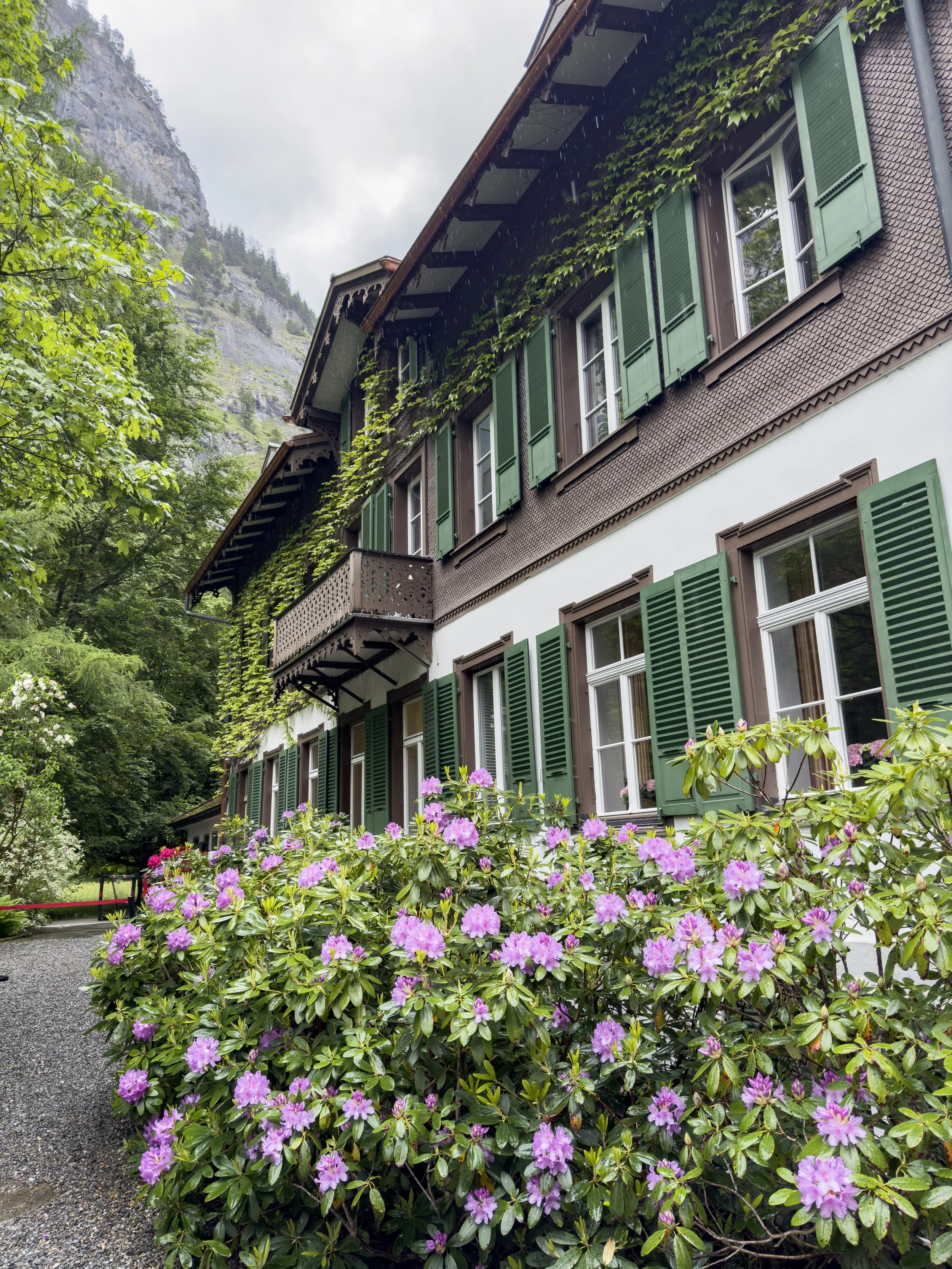
THE HOUSE THAT TELLS YOU WHERE YOU ARE
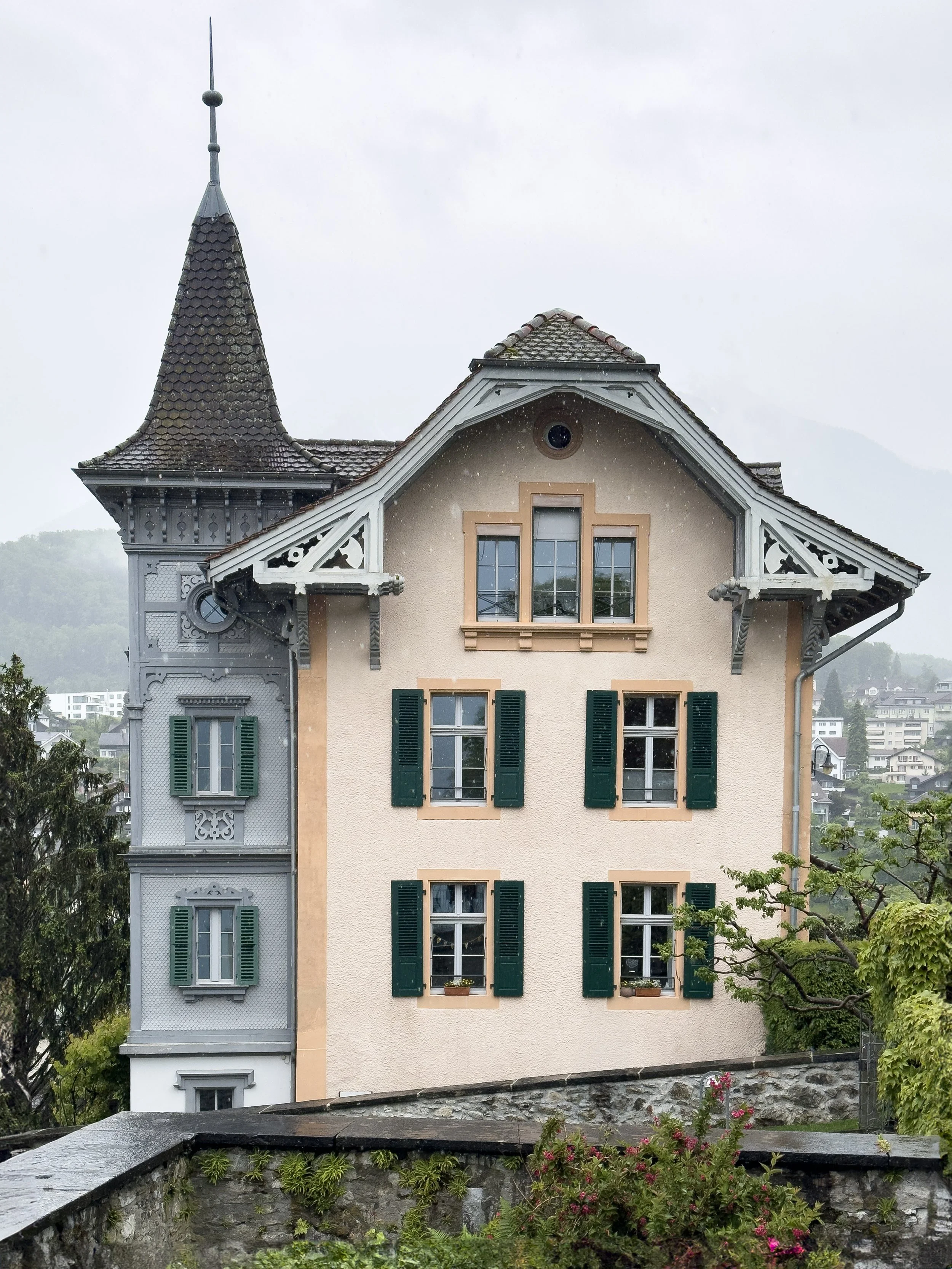
Start with the building everyone pictures: the chalet. The classic Alpine house is a lesson in patient decoration. The great overhanging eaves are trimmed with fretted and carved bargeboards, the balconies are worked into repeating patterns of hearts and scallops and pierced railings, and the heavy main beam is very often carved with a date and a blessing, a Haussprüche, a little inscription asking God's protection on the house and everyone who lives in it. Nothing structural required any of this. Someone chose to spend the winter making a functional building beautiful, according to a shared grammar of pattern that had been handed down for generations. That impulse, ornament as an act of care rather than a display of wealth, is the first thread, and it runs through everything.
THE TOWN THAT CARVES
Right on the shore of Lake Brienz, a short way from Interlaken, sits the village that turned this impulse into a whole economy. Brienz is Switzerland's woodcarving town, and its story is almost unbearably Swiss. In the famine year of 1816, a local wood turner named Christian Fischer began decorating small wooden goods with carvings and selling them to the first trickle of tourists, and when demand grew he taught the skill to his neighbors. By 1851 Brienz carving was winning prizes at the great London Exposition, and Victorian travelers were carrying home ever more elaborate carved bears and boxes and clocks. In 1884 the village founded a woodcarving school, still going today as the only place in the country where you can formally train in the craft. Wander the Brunngasse, an alley of carved wooden houses so lovely it was once voted the most beautiful in Europe, and you are looking at hardship turned, by sheer patience and skill, into a national art form. The bears, by the way, are everywhere, partly because they are the symbol of Bern and partly, a carver once cheerfully told us, because they are one of the easier things to carve.
PAPER, THREAD, AND THE ALPINE IDYLL
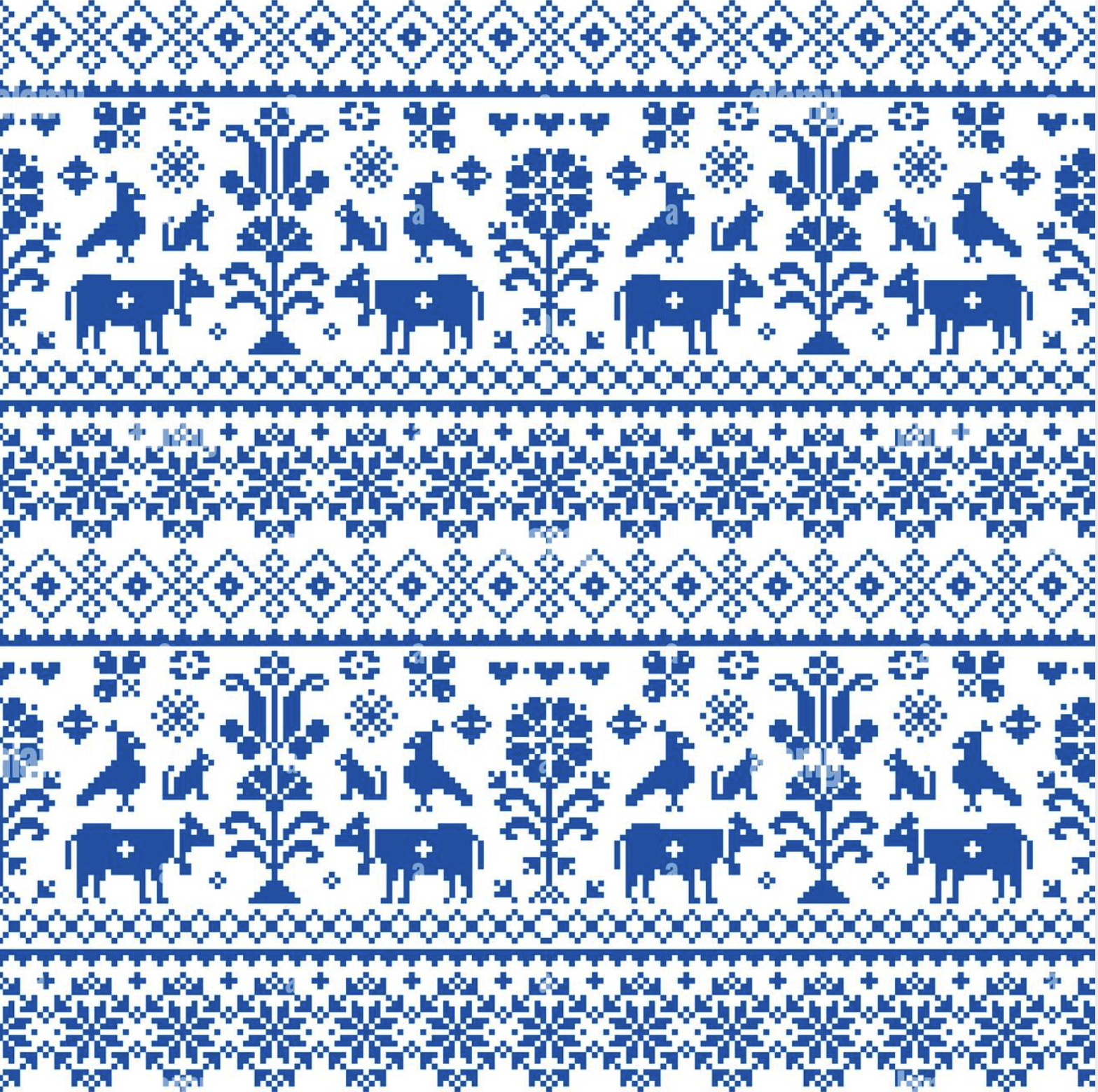
The same love of intricate, symmetrical pattern shows up wherever the Swiss have had a spare surface and a long winter. There is Scherenschnitt, the papercutting tradition practiced since the seventeenth century in the Bernese Oberland and, most famously, the Pays d'Enhaut, where nineteenth-century masters like Johann-Jakob Hauswirth and Louis Saugy cut astonishingly detailed black-paper scenes: mirror-image fir trees, hearts, and long processions of cows, all folk life rendered in silhouette. There are the poya paintings of the Fribourg country, bright naive pictures of the herds climbing to the summer pastures, painted across the fronts of farmhouses. And there is the embroidery, above all from Appenzell, the fine white-on-white floral cutwork that ornaments traditional costume and linen alike. Over and over you find the same motifs, the cow, the fir, the heart, the edelweiss, worked with obsessive symmetry and care. It is folk art, but it is folk art with the discipline of a watchmaker.
THE CROSS AND THE PRECISION
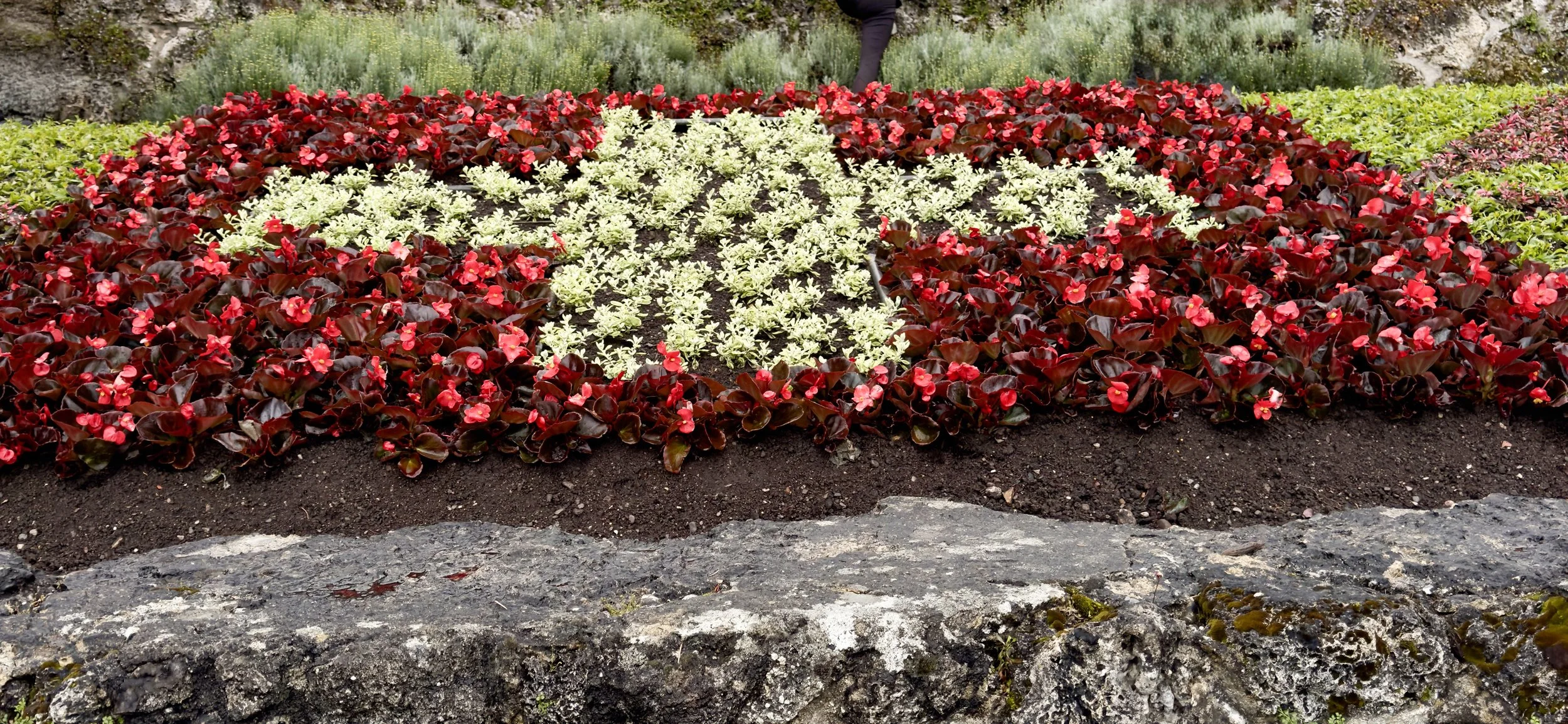
Which is the other half of the Swiss visual soul, and at first it looks like the opposite. Alongside all that lavish handwork sits a national genius for the clean, the exact, and the pared-down. The flag itself is the tell: a bold white cross on a red field, one of only two square national flags in the world, about as simple and legible as a mark can be. The watch dials, meanwhile, carry guilloché, intricate geometric patterns cut by precision engine-turning, the exact meeting point of ornament and engineering. Even the pocket knife has the cross on it. The Swiss, it seems, are equally at home with the wildly decorated and the ruthlessly plain, and we spent a while assuming these were two different national moods until we realized they are the same one.
THE PLOT TWIST: SWITZERLAND INVENTS THE MODERN LOOK
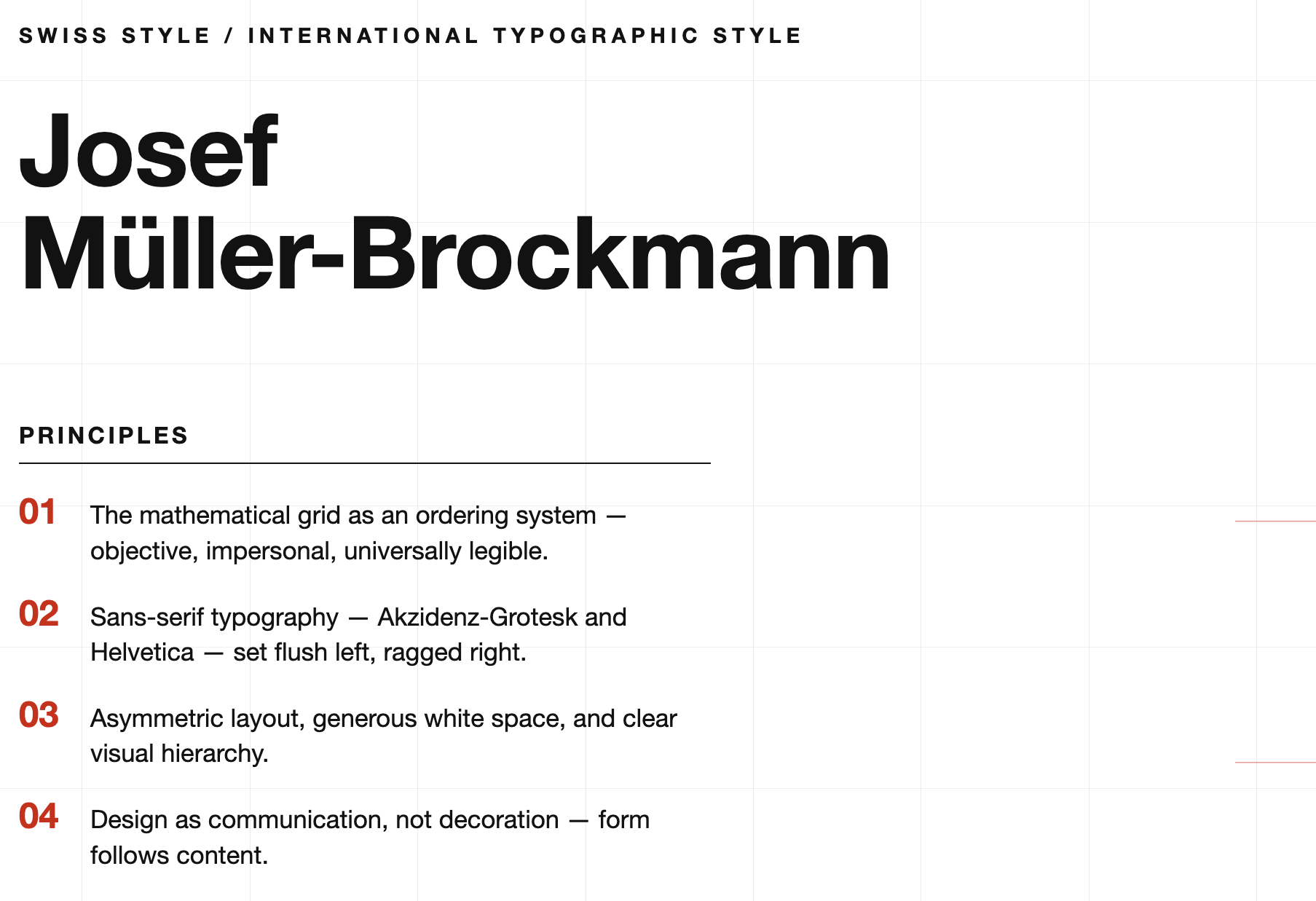
Here is the part that surprises people. The clean, gridded, sans-serif look that now signals "modern," "trustworthy," and "well-designed" in every airport, app, and annual report on earth is, to a remarkable degree, a Swiss invention. In the design schools of Basel and Zurich in the late 1940s and 1950s, a movement took shape that became known, fittingly, as the Swiss Style, or the International Typographic Style. Its practitioners, Josef Müller-Brockmann chief among them, built everything on the mathematical grid, favored clean sans-serif type and generous white space, and prized clarity above all decoration. And in 1957 the Swiss gave the world the typeface that would become the very sound of neutral competence: Helvetica, drawn by Max Miedinger with Eduard Hoffmann, and named, of course, for Switzerland itself. The country that produced the most intricate carved chalet in Europe also produced the most severely simple graphic design language of the modern age.
WHAT ACTUALLY MAKES IT "SWISS"
So which is it, the baroque balcony or the bare grid? The answer, and this is the whole point, is that they are not opposites at all. They are two expressions of a single underlying value, and that value is meticulous, patient, unshowy care. The carved chalet and the Helvetica timetable are both saying exactly the same thing to you: someone took immense trouble over this, nothing here is careless, everything is exactly where it should be and made as well as it could be made. Intricate or minimal is just a stylistic choice. Order, precision, and craft are the constants underneath, and those are what your eye is actually recognizing in that four-second flash of "ah, Switzerland."
THE LOOK IS THE BRAND
This is why "Swiss made" is worth real money stamped on the back of a watch, the handle of a knife, or the wrapper of a bar of chocolate. The look of the place and the brand of the place are the same thing, because both grow from the same national habit: doing things properly, down to the smallest detail, whether the detail is a carved edelweiss or the kerning on a railway sign. The trains run on time for the same reason the chalet beam is carved and the poster is set on a perfect grid. It is all one disposition, made visible.
Which means that when you stand in a Swiss village and feel, before you can explain it, that you are somewhere unmistakable, you are not responding to a color scheme or a cliché. You are reading, correctly, a centuries-deep commitment to care, expressed in wood and thread and paper and steel and type. It is one of the most coherent national brands on earth, and the lovely thing is that nobody had to design it as one. They just kept doing careful work, winter after winter, until the carefulness itself became the country's face.