
There is No Victor But God, … And Very Good Taste
What the Alcázar of Seville and the Alhambra of Granada quietly agree on
All future articles will be posted on our Substack at https://byhande.substack.com/
We were standing in the Real Alcázar of Seville, in a palace built by a Christian king, staring up at a wall of exquisite carved plaster, when someone who reads Arabic quietly pointed out what it actually said. Wa la ghalib illa Allah. There is no victor but God. It is written there over and over, hundreds upon hundreds of times, threaded through the stucco of a Catholic monarch's throne room. And a little further along, in the same beautiful Arabic script, the wall praises the Christian king himself and calls him, of all things, a sultan. We stood there for a while working through the pleasant confusion of it, and out of that confusion comes one of the best stories in all of southern Spain.
TWO PALACES THAT LOOK LIKE SIBLINGS
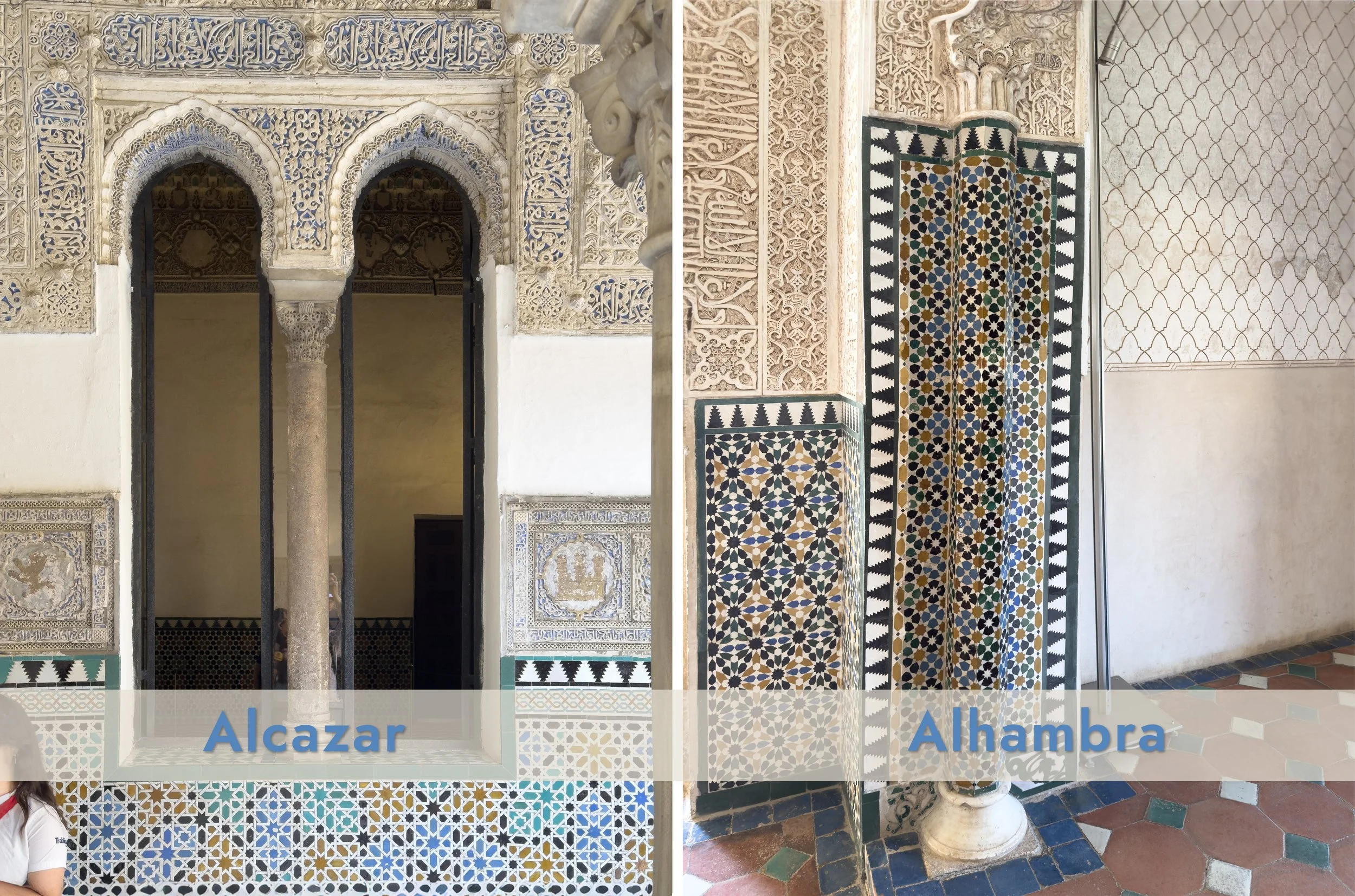
If you visit both the Alcázar in Seville and the Alhambra in Granada, and you should, ideally on the same trip, you will notice something before anyone explains it to you. They look like family. The same lace-like carved plaster. The same honeycombed vaults dripping from the ceilings like frozen stalactites, the muqarnas. The same glowing tilework, the same interlacing geometry, the same still courtyards built around water and open sky, the same sense that the real luxury is coolness, shade, and quiet.
This is odd, when you think about it, because one of these was the palace of the Nasrid sultans of Granada, the last Muslim kingdom in Iberia, and the other was the palace of Pedro I of Castile, a Christian king. Two rival faiths, two rival powers, and yet two palaces that could have been designed by the same hand. In a sense, they were.
THE FRIENDSHIP BEHIND THE STONES
Here is the part the guidebooks tend to rush past. In the 1360s, when Pedro I rebuilt the Alcázar in the ornate style we now call Mudéjar, he was close allies with Muhammad V, the Nasrid ruler of Granada. Their friendship was real and mutually useful; Muhammad had been deposed and driven into exile, and Pedro helped return him to his throne. When it came time to build, that alliance paid an unexpected dividend. The finest craftsmen in the peninsula were Muslim, and Pedro brought them in, artisans from Granada, from Toledo, from Seville itself, and it is very likely that Muhammad V simply sent some of his own. The Christian king's dream palace was raised, quite literally, by the hands of his Muslim ally's craftsmen, working in the visual language of the Alhambra they had just come from.
The word Mudéjar refers to exactly this: Muslim artisans working under Christian rule, and the astonishing fusion they produced. It is not a watered-down imitation of Islamic art. It is the real thing, made by the same people, for a different patron, and it is why a facade in Seville can carry a Latin inscription dated 1364 on the outside and an Arabic one dated 1366 within, the beginning and the end of the same building.
THE WALL THAT SPEAKS TWO LANGUAGES
Which brings us back to that motto. Wa la ghalib illa Allah, there is no victor but God, was the official motto of the Nasrid dynasty of Granada. It is carved into the Alhambra a genuinely absurd number of times, by some counts making up the majority of all the writing on those famous walls, thousands upon thousands of repetitions until the phrase becomes less a sentence than a texture, a heartbeat in stone.
And there it is again, in Seville, in the palace of the king who was, on paper, on the other side. The craftsmen carved their own motto into their new patron's home, and here and there they added a small cross to the Arabic, perhaps to soften it, perhaps as a private joke, perhaps as a tiny act of translation between two worlds. The same walls praise Pedro in flowing Arabic as a great and noble sultan. A Christian throne room that calls its Christian king a sultan, in Arabic, beneath a Muslim prayer repeated until it hums. You could not invent it, and nobody had to.
WHAT THEY WERE ACTUALLY AGREEING ON
It would be easy, and a little too neat, to call all this simple tolerance. The truth is more interesting. What these kings shared was not a theology. It was a taste, and beneath the taste, a philosophy of how to live well.
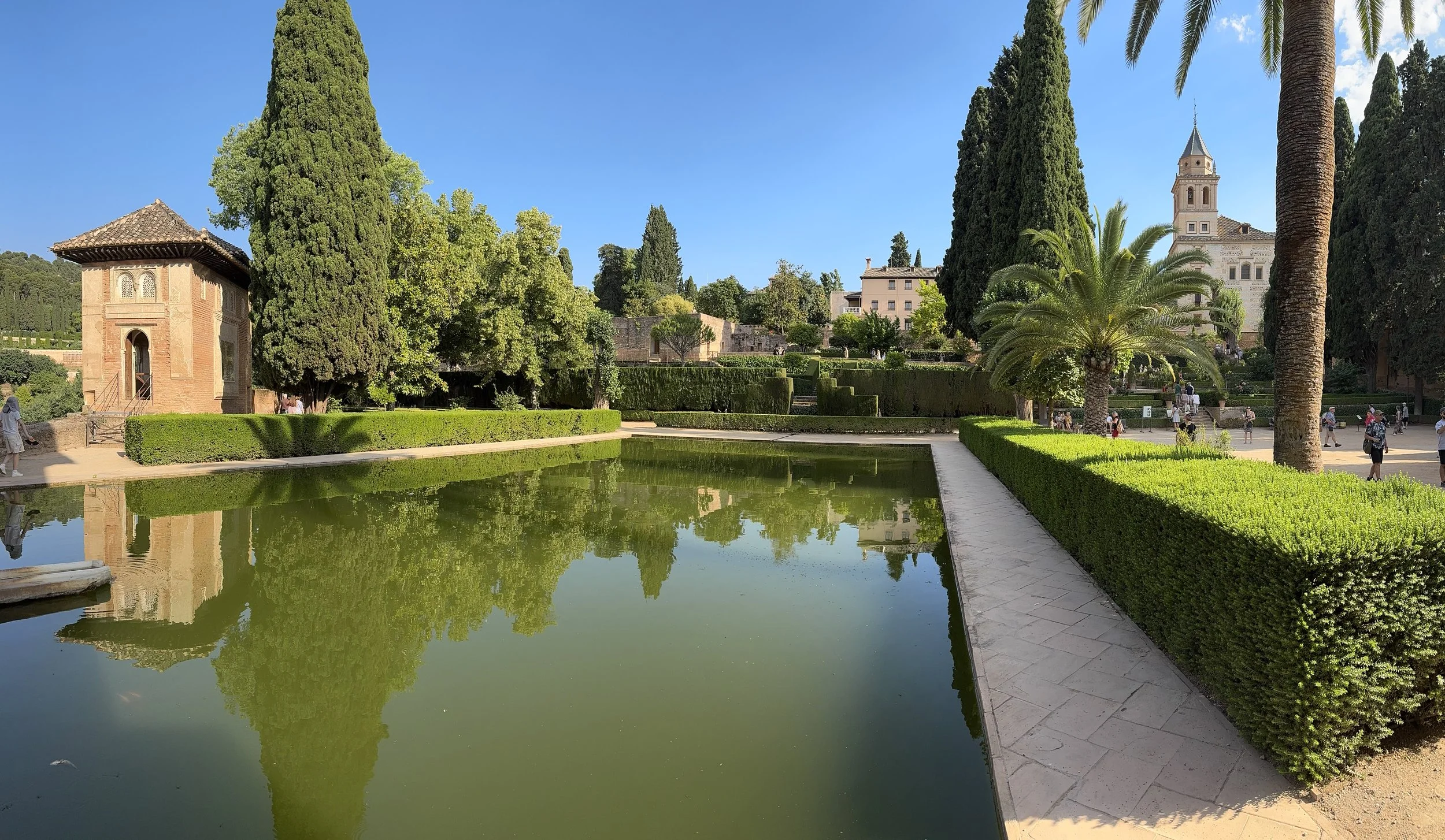
The Andalusi civilization had spent centuries perfecting something the rest of medieval Europe had barely imagined: the house as an earthly paradise. Water at the center of everything, running, still, reflecting, cooling. Rooms that turn their backs on the street and open instead onto private courtyards and gardens. Poetry carved directly into the walls, so that the architecture literally speaks to you. Light handled like a material. Beauty treated not as decoration applied at the end but as the entire point, a daily discipline, a way of being alive in a hot country with grace. The Christian kings who inherited these cities looked at all this and did not want to erase it. They wanted to live in it. They understood that the people who came before had figured out something worth keeping, and the highest compliment they could pay was to build in the same language.
That is the deeper essence your walk through these palaces is really tracing. Not who won, but what everyone, across the divide, agreed was beautiful.
THE HONEST SHADOW
We would be doing you a disservice to leave it there, all sweetness. This was not a paradise of harmony. The same centuries that produced these palaces were centuries of war, of shifting frontiers, of the long Christian reconquest that would end in 1492 with the fall of Granada and, before long, the expulsion of the very Muslim and Jewish communities whose genius built these walls. The comfortable word convivencia, coexistence, papers over a great deal of conflict. When the emperor Charles V later dropped a heavy Renaissance palace right into the middle of the Alhambra, he gave us the perfect image of the other impulse, the one that conquers and overwrites.
And yet. The Catholic Monarchs who took Granada also chose to preserve its palace, and to be buried in the city, plainly in love with the thing they had conquered. Pedro filled his throne room with his ally's prayer. The stones record both the fighting and the genuine, across-the-lines admiration, and both are true at once. That honesty is part of what makes the place so moving.
WHY YOU SHOULD SEE BOTH
Go to the Alhambra for the original, the improbable Nasrid dream on its hill above Granada. Go to the Alcázar in Seville for its Christian twin, built in the same breath by the same hands. See them close together if you can, because the conversation between them is the whole point, and it is a conversation you can still hear if you slow down and read the walls.
What southern Spain preserves, in the end, is not a winner. It is an idea of beauty that outlasted every king who ever fought to possess it. There is no victor but God, the walls insist, thousands of times, in the palaces of both faiths. We would only add, gently, that there does seem to have been one other thing nobody could conquer, and that everybody, in the end, agreed to inherit. Very good taste.