
What Southern Spain Knows About Living
Different answers to the questions we all ask
BY TATYANA & SCOTT • COSTA DEL SOL JOURNAL NO. 2 • 7 MIN READ
All future articles will be posted on our Substack at https://byhande.substack.com/
One of the great joys of travel is the discovery that other places have arrived at different answers to the same questions we all ask. Not necessarily better answers, we're suspicious of anyone who comes home from a week abroad certain they've found a superior way to live. Just different ones. And the value of a different answer is that it shows you your own assumptions for what they are: choices, presumptions, evolving thoughts and ideas.
Southern Spain is full of these discoveries. Some are obvious from the first afternoon, the architecture, the layered history, the food that tastes like the place it comes from. Others arrive more slowly, over days rather than minutes, and reveal themselves only if we stay long enough. Here are a few of them.
THE CLOCK
Time works differently here
The first thing many Americans notice in Andalusia is the rhythm of the day, and how unfamiliar it feels. Lunch stretches past the point where we'd have asked for the check. Dinner doesn't really begin until nine or ten. Conversations don't seem to be racing toward a conclusion. People linger.
After a time, we made the shift. We found ourselves sitting in restaurants after the plates were cleared, and noticed that no one was hovering with the bill, no one was anxious about the next thing, and the evening was simply allowed to unfold. It turns out the Spanish aren't being slow. They're doing something they have a specific word for, one we don't really have in English.
la sobremesa
“over the table”
The stretch of time spent at the table after the meal is finished, not eating, but talking, lingering, letting the conversation go where it wants over coffee or a last small glass. The Real Academia Española defines it simply as the time spent at the table after eating. Ask a Spaniard and they'll tell you it means more than that: it is where the friendship actually happens.
Somewhere along the way we realized how thoroughly modern life had trained us to believe every hour must produce something. Southern Spain doesn't argue with that belief so much as quietly ignore it. The sobremesa is not wasted time. By the local accounting, it may be the most important part of the meal.
THE STREET
Public space still belongs to people
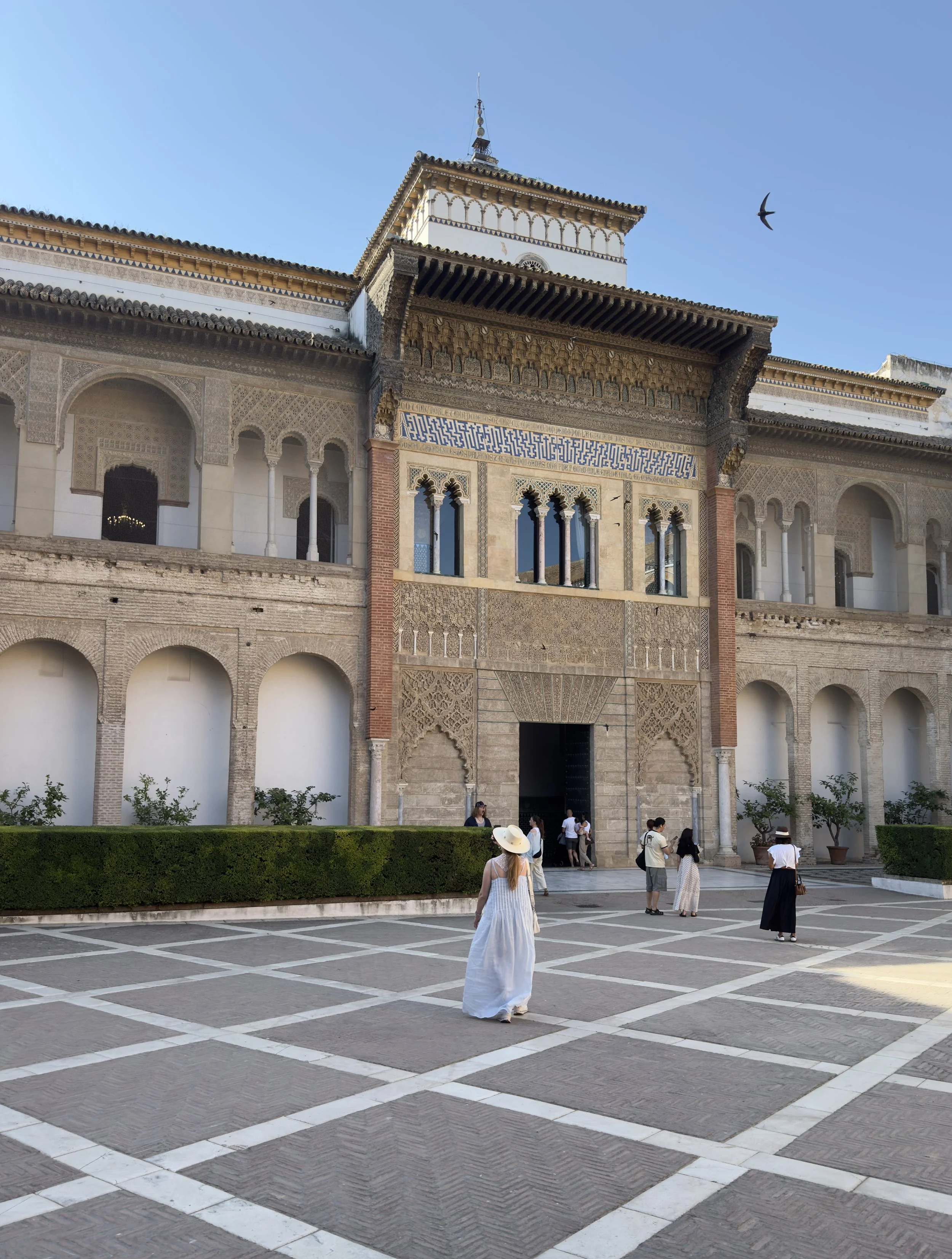
In much of American life, community has moved indoors, behind front doors, into cars, onto screens. In Andalusia, it is still out in the open, and the street itself is part of it. In the early evening the squares fill up. Families take the paseo, the unhurried walk that exists for no reason other than to be among other people. Children play outside well past the hour we'd consider late. Grandparents hold down the good benches and watch the world go by. Teenagers gather without needing a plan or a reservation.
What struck us most was how present everyone seemed. Not rushing, not isolated, not heads-down, just participating in the life happening around them. There is a practical wisdom in it, too. With mild winters and long, warm evenings, life in Andalusia simply happens outdoors, and a life lived partly in public turns out to be a life lived partly in company.
THE EVERY DAY
Beauty isn't reserved for the wealthy
One of the most quietly delightful things about Andalusia is how democratic its beauty is. You don't need a luxury resort to be surrounded by it. It's in the neighborhood plaza, the village church, the tiled courtyard glimpsed through an open door, the narrow whitewashed street lined with painted flowerpots, the long view across olive-covered hills going gold at the end of the day. None of it is behind a gate or a price.
This is, we think, one of Europe's greatest and least-discussed gifts: the conviction that beauty belongs woven into ordinary life rather than fenced off as a reward for those who can afford it. A working-class street in a white village can stop you in your tracks. The care is everywhere, and it's for everyone.
Beauty here hasn't been separated from daily life and sold back to people. It was simply left where it belongs.
THE CENTER
Relationships sit at the heart of it
Again and again, beneath the rhythm and the public squares and the everyday beauty, we noticed the same thing: people prioritized each other. Meals were social. Evenings were social. Public life was social. The whole pace of the day seemed quietly engineered to create occasions for connection rather than to eliminate them in the name of getting more done.
We're wary of romanticizing, every culture has its frustrations, and no place is perfect once you actually live there. But it's hard to ignore that this way of living appears to agree with people. Spain now has one of the longest life expectancies in the world, around 84 years, second only to Japan among the world's largest economies, and researchers credit not only the Mediterranean diet and good healthcare but the country's unusually strong social fabric.
23%
of older Spaniards live alone, against roughly 32% across Europe, one small measure of a culture built, by habit and design, around daily companionship.
Southern Spain reminded us of something easy to forget in a culture that measures a life mostly by what it accomplishes: that a life is also measured by its relationships. The two are not opposed. But only one of them tends to make it onto the calendar.
THE TAKEAWAY
What we brought home
Whenever we travel, we ask ourselves what can we bring back? Experiences. Ideas. Some sort of representation. A memory that stays with us. Andalusia sent us home with a short list that we try to honor.
To leave room for conversation. To sit a little longer once the meal is done. To walk sometimes without a destination, just to be among people. To be outside more. To notice ordinary beauty instead of saving our attention for the famous kind. To put time for the people we love on the calendar with the same attention we give everything else. And, most of all, to remember the thing the whole region seems to know in its bones: that a life is not only something to accomplish.
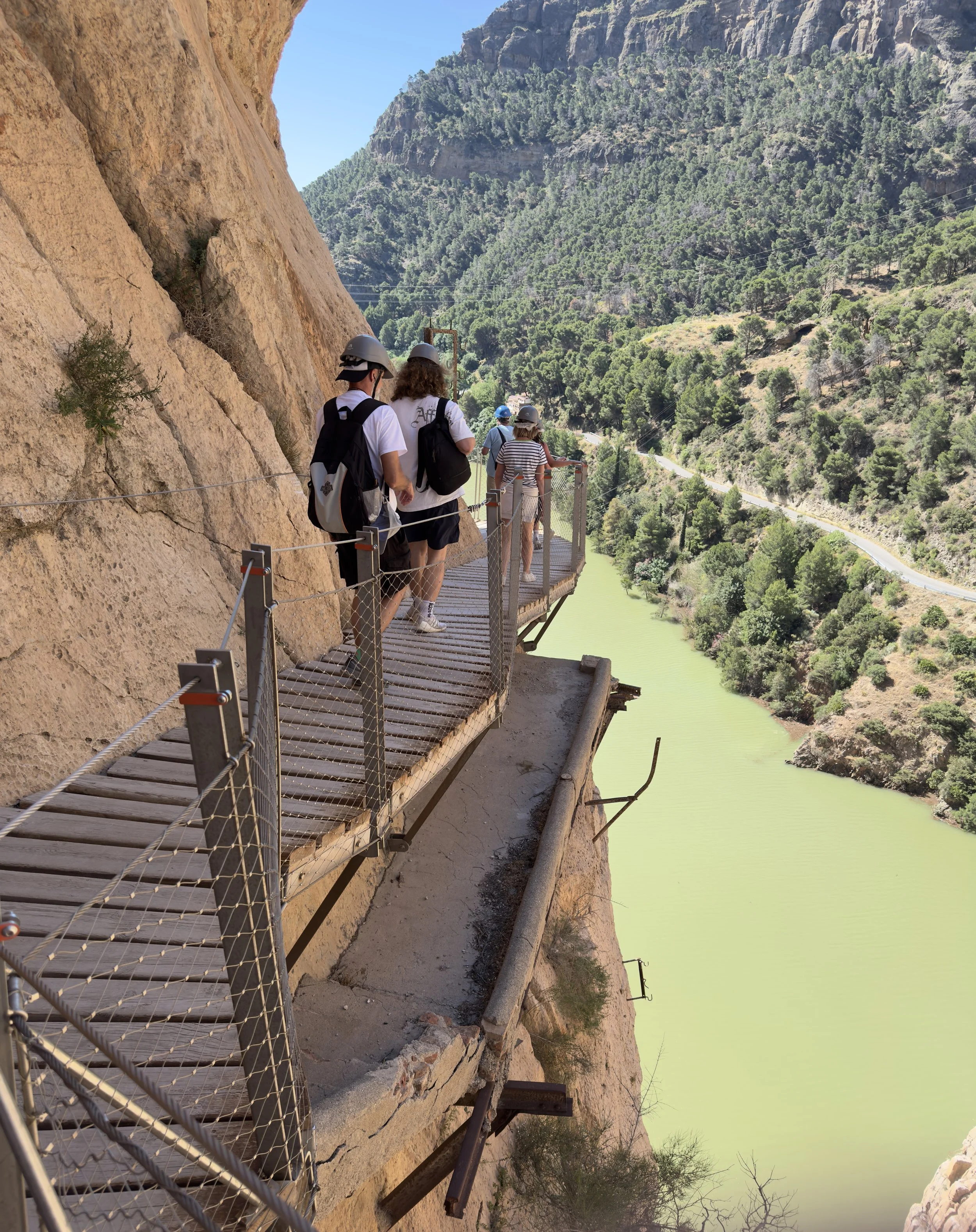
Caminito del Rey
So many cool experiences in Andalusia.